
This article contains promotional links (affiliate). We may earn a commission if you book through them, at no extra cost to you.
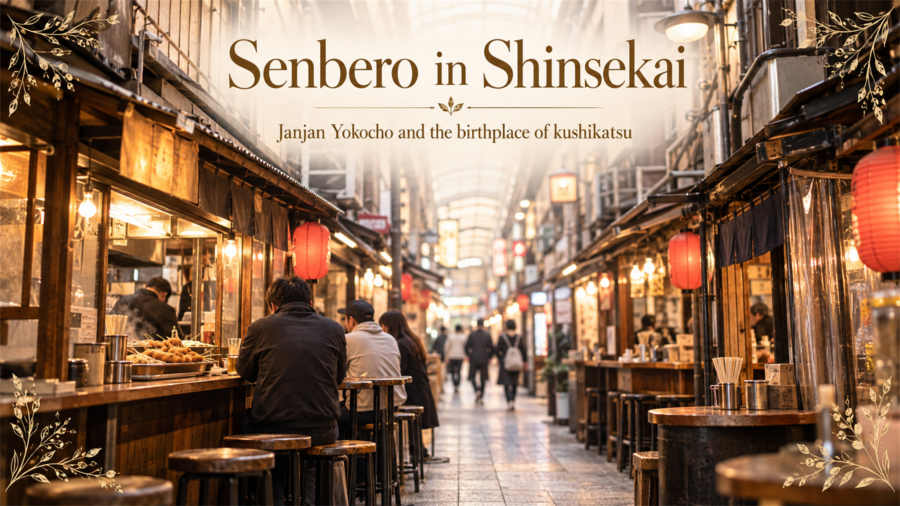
The name “Janjan Yokocho” sounds a little intimidating on paper. Walk down it, though, and it feels less edgy and more like stepping into a time capsule — faded signage, decades-old storefronts, and a genuinely relaxed, unpretentious atmosphere.
I’m Kei Hasumi, Chief Travel Auditor at HOTEL CHOICE GUIDE. We dug into the “senbero” (cheap-drinking) culture of Shinsekai and Janjan Yokocho across multiple sources. Some things online are stated far more confidently than the evidence supports — so here’s what we could actually confirm, and what we couldn’t.
- The real history and name origin of Janjan Yokocho
- What “senbero” actually means (and whether it really started here)
- The story behind Shinsekai’s kushikatsu culture and the “no double-dipping” rule
- Practical notes before you go
- Where to stay nearby once you’re done hopping bars
What is Janjan Yokocho?
Its official name is Nanyodori Shopping Street, but almost nobody uses it. The nickname comes from “jan-jan,” an onomatopoeia for the shamisen music shop owners once played to pull in customers (source: Japan’s Ministry of Land, Infrastructure, Transport and Tourism multilingual database; Wikipedia).
According to the sources we checked, the lane dates back to around 1921, had entertainment facilities including a public bathhouse before the war, was destroyed in the 1945 Osaka air raids, and reopened around 1950 as a theater district. It saw a resurgence in the 1960s as a cheap-eats destination for construction workers building Expo ’70, and was redeveloped in 1997 while preserving its retro character (sources: Wikipedia, MLIT database — though some of these specific years rely on single sources, so treat them as approximate).
Today it’s a mix of kushikatsu (deep-fried skewer) joints, sushi counters, standing bars, udon shops, okonomiyaki restaurants, and even shogi and go parlors and game centers — a working-class neighborhood with a genuinely lived-in feel. Many bars cater to night-shift workers with beer-included “morning sets” served early in the day (source: MLIT multilingual database).
What is “senbero,” and did it really start here?
“Senbero” is slang meaning roughly “1,000 yen to get wasted” (sen = 1,000, bero-bero = drunk). In practice, it usually refers to getting a decent snack plus 2-3 drinks for around 1,000 yen, rather than literal blackout drunk (source: Japanese Wikipedia and other secondary sources).
The term itself is generally credited to a 2003 book co-written by novelist Ramo Nakajima and editor Jun Kobori.
Here’s the honest part: we couldn’t verify the claim that senbero culture originated in Shinsekai or Janjan Yokocho specifically. It’s a common thing to read — “Janjan Yokocho is often cited as the birthplace” — but we couldn’t trace that back to an actual source. Shinsekai is absolutely one of the iconic senbero neighborhoods in Japan; just be cautious about claims that it’s THE birthplace.
Kushikatsu and the “no double-dipping” rule
Shinsekai means kushikatsu. “Kushikatsu Daruma,” with a branch in Janjan Yokocho, is one of the most consistently cited names in food guides — founded in 1929 and often described as the originator of Shinsekai-style kushikatsu (source: restaurant portals including Gnavi and Funliday; we couldn’t confirm this via an official company site).
The famous “no double-dipping” rule — don’t dip a bitten skewer back into the shared sauce — is a real house rule at many shops. The commonly cited reason is hygiene, since the sauce pot is shared by the whole counter (source: Mynavi News, 2013), though we couldn’t find an official record of exactly when or where the rule originated. Free shredded cabbage is commonly offered alongside the skewers, though this varies by shop.
Stay in Shinsekai after your bar-hopping night
The whole point of bar-hopping is not having to travel between stops. Don’t ruin it by taking a late train home — base yourself in Shinsekai and sleep it off with an easy, unhurried checkout the next morning.
| Hotel | Why it works | Check rates |
|---|---|---|
| Hiyori Hotel Osaka Shinsekai | Right inside Shinsekai, a convenient base for hopping between bars | Check rates on Agoda 〉 |
| KOKO HOTEL Osaka Shinsekai | About 2 minutes’ walk to Tsutenkaku, 24-hour coin laundry on-site | Check rates on Agoda 〉 |
| Bande Hotel in Namba | Walking distance from Shin-Imamiya Station, rooms built for groups | Check rates on Agoda 〉 |
| Toyoko Inn Osaka Tsutenkaku-mae | Free breakfast the next morning before you head out | Check rates on Agoda 〉 |
Being tipsy and far from your hotel is never fun. Our team researches real guest reviews before recommending any hotel in Shinsekai — use this list to pick a base close enough to walk home.