
This article contains promotional links (affiliate). We may earn a commission if you book through them, at no extra cost to you.
“Wait, people still play shooting galleries in Shinsekai?” A friend visiting from overseas asked me that under Tsutenkaku Tower, half-joking. I took them to try one anyway — and they ended up more hooked than I expected.
I’m Kei Hasumi, Chief Travel Auditor at HOTEL CHOICE GUIDE. Shinsekai and the area around Tsutenkaku Tower is one of the few parts of Osaka where Showa-era (roughly 1950s-80s) arcade games — shooting galleries, smart ball parlors — are still genuinely in business, not recreated for tourists. You’ll also see the claim online that Shinsekai is “the birthplace of pachinko.” We dug into that one, and it turned out to be shakier than most articles suggest. Here’s what we actually found, good and questionable parts included.
- Where to actually play shooting galleries and smart ball in Shinsekai today
- What we found digging into the “birthplace of pachinko” claim (short answer: it doesn’t hold up)
- What to check before you go (hours, cash, age limits)
- Where to stay in Shinsekai so you can walk back after dark
Shooting gallery: Hihokan Honten
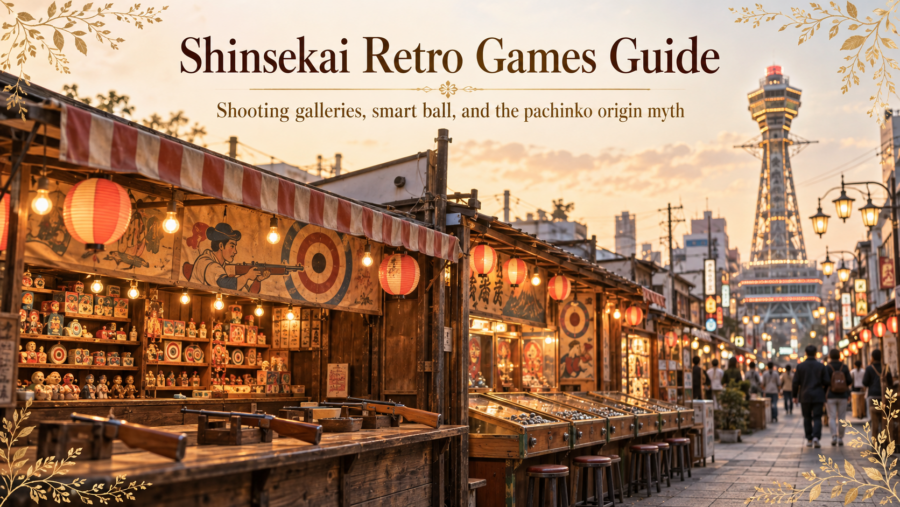
About a 90-second walk from Tsutenkaku Tower, at 2-4-10 Ebisuhigashi, Naniwa-ku, sits Hihokan Honten — an old-school amusement hall built around a shooting gallery. The shop’s own signage claims an 11-meter-wide counter, billed as the largest shooting gallery in Japan, and a sign reading “first officially licensed postwar shooting gallery in Osaka Prefecture” (source: ITmedia NLab, October 2020).
To be upfront: both the “largest in Japan” and “first licensed” claims come from the shop itself and the article that covered it — we couldn’t find independent verification of either. Think of it less as a verified fact and more as classic, unapologetic shitamachi (old-town) marketing.
As of the 2020 writeup, the 2nd floor housed a retro game center (vintage electro-mechanical games), with a planned maze/haunted house on the 3rd floor. Smart ball is also playable in the same building. The operator runs the same company as “Zarigani,” a small chain of game centers around Shinsekai, described in the article as “68 years in business in Osaka” at the time. Cash is the standard payment method (source: osaka-info.jp).
Smart ball at “New Star”
At 3-5-19 Ebisuhigashi, “New Star” (ニュースター) is a smart ball parlor worth a visit if you’re into Showa nostalgia. It’s about a 4-minute walk from Osaka Metro Dobutsuen-mae Station, or 8 minutes from JR Shin-Imamiya Station (source: Timeout Osaka, October 2023).
The rules are simple: one 100-yen coin buys you 25 balls. Leftover balls can be exchanged for snacks or small toys, 20 balls at a time. There are seven machine types with different pin layouts, and landing in the center “15” hole triggers a “Lucky Chance” bonus. The article describes around 50 machines that have “looked the same for over 50 years,” though we couldn’t confirm the shop’s actual founding year. As with pachinko parlors, you must be 18 or older to enter.
Hours: weekdays 11:30am-10pm, weekends/holidays 10am-10pm. Closed Tuesdays, with occasional unscheduled Wednesday closures — a quick phone check before visiting is a good idea.
Is Shinsekai really the “birthplace of pachinko”? We checked.
You’ll see articles describing Shinsekai as “the birthplace of pachinko.” We cross-checked this against several sources to see how solid the claim actually is.
Short version: we couldn’t find solid evidence that Shinsekai, or Osaka generally, is THE birthplace of pachinko. What we did find is that pachinko’s origins are genuinely contested, with several competing theories:
- Nagoya theory (best documented): In 1930, Aichi prefectural police are said to have issued Japan’s first formal indoor amusement-hall license, for a private home in Nagoya. The machine involved was likely an early “one-sen pachinko,” so whether it counts as “real” pachinko by modern standards is debated.
- Takarazuka theory: In 1923, a European-made “wall machine” was reportedly installed at Takarazuka’s hot-spring resort — the earliest known installation, though the word “pachinko” didn’t exist yet.
- Osaka/Kobe street-stall theory: From the late Taisho into early Showa, street vendors in Osaka and Kobe are said to have modified imported machines into vertical game cabinets for festival stalls, nicknamed “gachagacha” or “pachipachi.” One account claims around 3,000 such operators in Osaka alone — but this is closer to hearsay, with almost no surviving machines or records to back it up.
So “Shinsekai invented pachinko” isn’t accurate. What’s more defensible is that the street-stall culture of late-Taisho/early-Showa Osaka and Kobe is one of several threads in pachinko’s tangled origin story. If you see a confident “birthplace of pachinko” claim in a brochure, it’s worth taking with a grain of salt.
History aside, the fact that Shinsekai still has working smart ball parlors and shooting galleries today — relics from the pachinko era and before — is genuinely rare. You won’t find that combination easily anywhere else in Japan.
Stay in Shinsekai, skip the late-night commute
Both shooting galleries and smart ball stay open into the evening, and once you add drinking and street food to the mix, you’ll want your hotel within walking distance — not a train ride away.
| Hotel | Why it works | Check rates |
|---|---|---|
| Toyoko Inn Osaka Tsutenkaku-mae | Walking distance to the Tsutenkaku area, free breakfast included | Check rates on Agoda 〉 |
| KOKO HOTEL Osaka Shinsekai | About 2 minutes to Tsutenkaku on foot, non-smoking rooms with Simmons beds | Check rates on Agoda 〉 |
| the b osaka-shinsekai | Compact, well-located hotel inside the Shinsekai area | Check rates on Agoda 〉 |
| APA Hotel Namba Minami Ebisucho | 1-minute walk from Ebisucho Station, connecting rooms for 2-4 guests | Check rates on Agoda 〉 |
| Spa World Hotel & Resort | Right by Dobutsuen-mae Station, with a huge onsen-style spa to unwind in afterward | Check rates on Agoda 〉 |
Our team at HOTEL CHOICE GUIDE researches real guest reviews before recommending any hotel in Shinsekai or Umeda. Pair this guide with your retro-game itinerary and book with confidence.