

This site may earn a commission if you book through some links on this page, at no extra cost to you. Hotel prices, room availability, and policies can change at any time — always check the latest details on the official hotel site or your booking platform of choice before you reserve.
Nothing quite prepares you for stepping out of a station exit into Shibuya Scramble Crossing for the first time — thousands of people moving in every direction at once, neon signs stacked three and four stories high, and somehow no one bumping into anyone. Tokyo has a way of living up to the version you’ve seen in movies and games while still surprising you daily with something smaller: a vending machine that sells hot coffee in a can, a side-street ramen counter with a line out the door at 11pm, a convenience store onigiri that’s better than it has any right to be. Where you stay shapes how much of that you get to experience without friction — this guide is about choosing the hotel that lets you focus on the city instead of the logistics.
Quick verdict
If you’ve never been to Tokyo before, the hotel you pick matters less for luxury and more for how easily it keeps you oriented. For most first-timers who want a simple, well-connected base with strong English support, Shibuya Excel Hotel Tokyu is the easiest starting point since it sits directly inside Shibuya Station’s Mark City complex. If clear airport logistics matter more than anything else — especially on a jet-lagged arrival day — The Tokyo Station Hotel is hard to beat, since Haneda and Narita both connect from the same station it sits inside. Travelers who want more breathing room in the room itself, and don’t mind a short walk from the station, may prefer Park Hyatt Tokyo or, for a self-catering apartment-style stay near Asakusa’s temples, Mimaru Tokyo Asakusa Station. Each option below comes with trade-offs worth knowing before you book.
Comparison table
| Hotel | Area | Nearest Station / Walk Time | Airport Access | Room Size (if known) | English Support | Best For | Main Drawback |
|---|---|---|---|---|---|---|---|
| Park Hyatt Tokyo | Shinjuku (Nishi-Shinjuku) | Tochomae Sta. ~10 min walk / Shinjuku Sta. ~12 min walk (not directly connected) | Limousine Bus to both Narita and Haneda, ~70 min (multi-stop, time varies) | 45–290 sqm (484+ sqft) | Full English-language site; staff English is frequently praised in reviews | Travelers who want spacious rooms and don’t mind a genuine walk from the station | Not connected to a station; spa and pool cost extra |
| Shibuya Excel Hotel Tokyu | Shibuya | Directly connected to Shibuya Station (inside Mark City) | Limousine Bus stop at Mark City; Narita service requires advance online booking | ~30 sqm (60.5 sqm for the accessible room) | English, Korean, and Chinese official site | First-timers who want zero-guesswork station access | Rooms are sized like a typical Japanese business hotel and may feel small |
| The Tokyo Station Hotel | Marunouchi (inside Tokyo Station) | Physically inside Tokyo Station’s Marunouchi south wing | Haneda ~30 min by monorail; Narita ~60 min by Narita Express — both depart from the same station | 23–95 sqm, depending on room type | Full English site; hotel offers a Meet & Greet service | Travelers prioritizing airport and Shinkansen connections above all else | The hotel entrance itself can be genuinely hard to find inside the sprawling station building |
| Mimaru Tokyo Asakusa Station | Asakusa | ~1–2 min walk from Asakusa Station | Not specifically confirmed for this property at time of writing | 40+ sqm (apartment-style, aggregate figure) | English-language site and booking exist; an explicit “English-speaking staff” guarantee was not confirmed | Families or groups wanting more space and a kitchen, near Asakusa’s sights | No breakfast service — self-catering kitchen instead, by design |
How to choose
Before comparing hotel amenities, it helps to answer a few honest questions about the kind of trip you’re taking:
- Which part of Tokyo will you actually spend the most time in? Shinjuku, Shibuya, and Asakusa each have a very different feel and pull you toward different sightseeing routes — pick the area first, not just the hotel.
- How much do you value single-station simplicity versus room space? A hotel directly connected to a station (like Shibuya Excel or Tokyo Station Hotel) minimizes the chance of getting lost with luggage, but often means a smaller room. A hotel with a short walk (like Park Hyatt) may offer more space in exchange.
- Is your arrival day going to be exhausting? If you’re landing after a long-haul flight, a hotel with unambiguous airport transfer options (The Tokyo Station Hotel) can matter more than anything else on day one.
- Do you need a working kitchen or laundry, or would you rather have breakfast handled for you? Mimaru’s apartment-style layout trades breakfast service for cooking space — great for some travelers, a non-starter for others.
- How many large suitcases are you bringing, and for how many people? Room sizes below are listed in square meters/feet specifically because “hotel room” means something very different in Tokyo than it does in most of North America or Europe.
Park Hyatt Tokyo
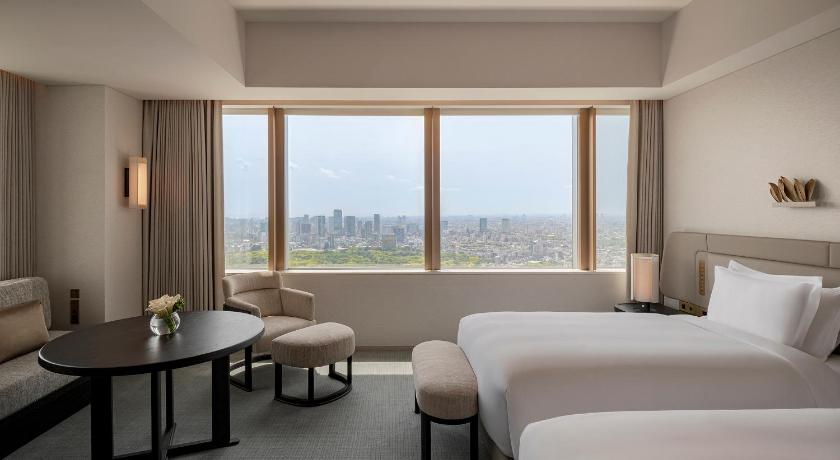 Photo via Agoda
Quick verdict: A spacious, English-fluent hotel best suited to first-timers who are comfortable with a genuine walk to the nearest station in exchange for noticeably more room to unpack and relax.
Best for: Travelers who want above-average room size, a well-reviewed English-speaking staff, and don’t mind arranging their own transport rather than walking straight off a train platform.
Not ideal for: Anyone who wants to step off the subway and be in their room within a couple of minutes, or who is watching every yen and doesn’t want to pay extra for spa or pool access.
Key facts:
- Area: Shinjuku (Nishi-Shinjuku)
- Room size: 45–290 sqm (484+ sqft) according to the hotel’s official information
- Nearest station: Tochomae Station, about a 10-minute walk, or Shinjuku Station, about a 12-minute walk
- Airport access: Limousine Bus service to both Narita and Haneda, roughly 70 minutes, though this can vary since the bus makes multiple stops
- English support: full English-language official site; staff English ability is frequently praised in recent guest reviews
What booking sites may not make obvious: This is one detail worth being upfront about — Park Hyatt Tokyo is not directly connected to Shinjuku Station. Listing photos and area descriptions can make it easy to assume you’ll walk straight from the platform into the lobby, but in reality it’s roughly a 10–12 minute walk (via Tochomae Station or Shinjuku Station). This matters if you’re arriving with heavy luggage or in bad weather — budget the extra time and consider a taxi from the station on your first arrival rather than walking it blind. Also, recent guest reviews often mention that the spa and pool are not included in the room rate, so factor that in if wellness facilities were part of your decision to book here.
Main drawback: The walk from either nearby station is real, not a rounding error — this is not a hotel where you can assume “close to the station” means “attached to the station.”
How to avoid the drawback: Plan your first arrival with a taxi or the Limousine Bus rather than attempting the walk with luggage, especially after a long flight. Once you know the route, later trips on foot are straightforward.
Where to check availability: Visit the official hotel website | Check on Agoda › for current rates and room options. Consider another option on this list if walking distance from a station is your top priority.
Read our full, in-depth review of Park Hyatt Tokyo ›
Shibuya Excel Hotel Tokyu
 Photo via Agoda
Quick verdict: The most straightforward station access on this list — this hotel sits inside Shibuya Station’s Mark City complex, which matters a lot if getting lost with luggage is one of your bigger travel anxieties.
Best for: First-time visitors who want to minimize navigation stress above all else, and who are comfortable with a room sized like a standard Japanese business hotel.
Not ideal for: Travelers who need a larger room to spread out, or light sleepers who want to avoid any chance of street or building noise.
Key facts:
- Area: Shibuya
- Room size: approximately 30 sqm for standard rooms (the accessible room is listed at 60.5 sqm) according to the hotel’s official information
- Nearest station: directly connected to Shibuya Station, inside the Mark City complex
- Airport access: a Limousine Bus stop is located at Mark City; the Narita bus service requires advance online booking
- English support: official site available in English, Korean, and Chinese
What booking sites may not make obvious: Listing sites tend to advertise the “direct station connection” heavily (accurately — this is a real strength), but say less about room size. At roughly 30 sqm, standard rooms here are sized like a typical Japanese business hotel and may feel small if you’re used to Western hotel standards, especially for two people traveling with full-size suitcases. Recent guest reviews also occasionally mention thin walls and some noise between rooms, so this may not be ideal if you’re a very light sleeper.
Main drawback: Standard room sizes are on the smaller side, and a few reviewers have mentioned noise carrying between rooms.
How to avoid the drawback: If room size is a real concern, check whether a higher room category or the accessible room (60.5 sqm) is available before booking a standard room, and pack luggage that can be stored flat under or beside the bed rather than needing full floor space to open.
Where to check availability: Visit the official hotel website | Check on Agoda › for current rates and room options. Consider Park Hyatt Tokyo instead if room space matters more to you than direct station access.
Read our full, in-depth review of Shibuya Excel Hotel Tokyu ›
The Tokyo Station Hotel
 Photo via Agoda
Quick verdict: Unmatched for airport and rail logistics — this is the only hotel on this list that is physically inside a train station, which removes an entire category of first-timer anxiety about connections.
Best for: Travelers who are arriving directly from the airport, connecting onward by Shinkansen, or who simply want the least ambiguous transport logistics possible on a first trip.
Not ideal for: Anyone who wants a hotel that’s simple to walk to on arrival — the station itself is enormous, and finding the hotel entrance is a real first-timer challenge in its own right.
Key facts:
- Area: Marunouchi, inside Tokyo Station
- Room size: 23–95 sqm depending on room type, according to the hotel’s official information
- Location: physically located inside Tokyo Station’s Marunouchi south wing
- Airport access: Haneda Airport in about 30 minutes by monorail; Narita Airport in about 60 minutes by Narita Express — both depart from the same station the hotel sits inside
- English support: full English-language site, plus a Meet & Greet service for arriving guests
What booking sites may not make obvious: Being “inside Tokyo Station” sounds simple, but Tokyo Station is one of the largest and most complex train stations in the world, with multiple exits, levels, and shopping concourses. Recent guest reviews often mention that the hotel entrance itself can be genuinely hard to find on first arrival, particularly if you come up from the wrong exit or platform. This is worth knowing in advance so you aren’t caught off guard while dragging luggage through a crowded station — it doesn’t take away from the hotel’s real strength, which is that once you’re checked in, your airport and Shinkansen connections are about as simple as Tokyo gets. Breakfast at The Atrium is also generally well reviewed but is priced at a premium compared to grabbing something outside the hotel.
Main drawback: Locating the actual hotel entrance inside the station can be confusing, especially arriving for the first time with luggage.
How to avoid the drawback: Look up the Marunouchi South Exit specifically before you arrive, and consider using the hotel’s Meet & Greet service if you’re arriving directly from the airport — staff can walk you in rather than leaving you to navigate the station alone.
Where to check availability: Visit the official hotel website | Check on Agoda › for current rates and room options. Consider Shibuya Excel Hotel Tokyu instead if you’d rather have a simpler building to navigate on arrival, even without the same airport connections.
Read our full, in-depth review of The Tokyo Station Hotel ›
Mimaru Tokyo Asakusa Station
 Photo via Agoda
Quick verdict: An apartment-style option that trades a hotel breakfast for genuinely more living space and a kitchen — a deliberate design choice rather than a missing amenity, and one that suits families and longer stays particularly well.
Best for: Families, small groups, or anyone staying multiple nights near Asakusa who would rather cook some meals and have room to spread out than rely on a hotel restaurant.
Not ideal for: Travelers who want breakfast included and handled for them, or who prefer a traditional hotel-service experience over a self-catering apartment setup.
Key facts:
- Area: Asakusa
- Room size: 40+ sqm (aggregate figure across room types), an apartment-style layout with sofa beds
- Nearest station: about a 1–2 minute walk from Asakusa Station
- Airport access: not specifically confirmed for this property at the time of writing
- English support: an English-language site and booking process exist; an explicit guarantee of English-speaking staff was not confirmed in the hotel’s official information
What booking sites may not make obvious: This is the key thing to know before booking: Mimaru Tokyo Asakusa Station does not offer a breakfast service. This isn’t an oversight — it’s by design. Rooms are set up apartment-style with a self-catering kitchen instead, which is exactly why the rooms here run larger (40+ sqm) than most hotel options in Asakusa. Consider this hotel if you’d genuinely rather have the extra space and the option to cook than a hotel breakfast buffet — and consider another option on this list if breakfast being included matters to you. Recent guest reviews also mention that laundry machines can have a wait at busy times, and that curtains don’t always fully block outside light, both worth knowing for lighter sleepers.
Main drawback: No breakfast service, and shared laundry facilities can mean a wait during busy periods.
How to avoid the drawback: Plan to pick up breakfast items nearby (Asakusa has no shortage of cafes and convenience stores within a couple of minutes’ walk) and, if laundry is part of your plan, try to run it outside of peak evening hours.
Where to check availability: Visit the official hotel website | Check on Agoda › for current rates and room options. Consider The Tokyo Station Hotel or Shibuya Excel Hotel Tokyu instead if you’d prefer breakfast included as part of your stay.
Read our full, in-depth review of Mimaru Tokyo Asakusa Station ›
Common mistakes first-time visitors make
- Choosing a hotel based on landmark proximity alone. Being “near” a famous sight doesn’t tell you much about how easy the hotel itself is to reach with luggage — station access matters more day to day than distance to a single landmark.
- Underestimating how much luggage space a room actually has. Room sizes in Tokyo are generally smaller than in North America or Europe; check the square meter/foot figures above rather than assuming a “standard room” matches what you’re used to.
- Assuming every hotel offers the same level of English support. Official English-language sites are a good sign, but the depth of in-person English support at the front desk can vary — when in doubt, check recent guest reviews for specific mentions.
- Not accounting for airport transfer time and transfers. “Airport access” can mean a direct train or a bus with multiple stops — these are very different experiences after a long flight, so check the specifics rather than assuming all options are equally fast.
- Assuming a station-connected hotel means a large room, or vice versa. As the comparison table above shows, the easiest station access and the largest rooms tend to be a trade-off, not a package deal.
- Booking without checking tattoo or public bath policies in advance, if a hotel spa, pool, or onsen-style facility is part of the appeal — policies vary by property and aren’t always clearly stated on booking sites.
Who should choose which hotel
- Solo travelers who want to minimize navigation stress on a first trip may lean toward Shibuya Excel Hotel Tokyu, given its direct station connection, or The Tokyo Station Hotel if arriving straight from the airport.
- Couples who want more room to unpack and relax, and don’t mind a short walk from the station, may prefer Park Hyatt Tokyo.
- Families who want extra space, a kitchen, and flexibility around meals will likely get the most out of Mimaru Tokyo Asakusa Station — just plan around the lack of breakfast service.
- Business travelers who need fast, unambiguous connections to Haneda or Narita and possibly the Shinkansen may find The Tokyo Station Hotel the most efficient base, even with the station’s confusing layout on arrival.
Where to check availability
Each hotel above links to its official website, which is the most reliable place to confirm current rates, room availability, and any policy changes before booking. You may also want to compare prices on Agoda, since promotions can differ by channel — just be sure to check the details (cancellation policy, exact room type, taxes and fees) against the official site before you commit.
FAQ
What area of Tokyo is best for a first-time visitor?
There isn’t a single correct answer — it depends on what you value most. Shinjuku and Shibuya are major transit hubs with easy onward travel, Marunouchi (Tokyo Station) is unmatched for airport and Shinkansen access, and Asakusa puts you close to some of Tokyo’s most visited historic sights. Consider this hotel list a starting point for comparing those trade-offs directly.
Do Tokyo hotels have English-speaking staff?
It varies by property. All four hotels above maintain English-language websites, and guest reviews for Park Hyatt Tokyo and The Tokyo Station Hotel specifically mention positive experiences with English-speaking staff. For Shibuya Excel Hotel Tokyu and Mimaru Tokyo Asakusa Station, English materials and booking are available, though an explicit staff-language guarantee wasn’t confirmed in official sources — check the latest details before booking if this is a priority for you.
How far in advance should I book a hotel in Tokyo?
This depends heavily on season and events happening in the city, and specific availability windows aren’t something this article can responsibly predict. As a general practice, book earlier for cherry blossom season (spring) and autumn foliage season, and check the hotel’s official site or your booking platform for current availability rather than relying on a fixed rule of thumb.
Are hotel rooms in Tokyo really smaller than in the West?
Often, yes, especially in business hotels near major stations — Shibuya Excel Hotel Tokyu’s roughly 30 sqm standard rooms are a good example of the typical size. That said, it isn’t universal: Park Hyatt Tokyo’s rooms start considerably larger, and Mimaru Tokyo Asakusa Station’s apartment-style rooms run 40+ sqm. Checking the specific square meter/foot figures for each hotel, as in the comparison table above, is more useful than assuming a blanket rule.
What’s the easiest way to get from the airport to my hotel?
This varies significantly by hotel. The Tokyo Station Hotel has the clearest, most direct routing since it sits inside the station both the Haneda monorail and the Narita Express serve. Park Hyatt Tokyo and Shibuya Excel Hotel Tokyu both have Limousine Bus access, though travel time can vary with stops and traffic. Check the airport access details for your specific hotel before finalizing your itinerary.
Should I book directly with the hotel or through a platform like Agoda?
Both are reasonable options, and pricing or perks can differ between them at any given time. Compare the official hotel website against your preferred booking platform for the same dates before you book, and pay attention to cancellation terms, since these can differ even for the same room type.
Related Tokyo hotel guides
- Best Tokyo Hotels with Large Rooms — if space to unpack matters more than station access.
- Best Hotels Near Tokyo Station — a closer look at the Marunouchi and Yaesu sides, including The Tokyo Station Hotel in more depth.
Final notes
Hotel prices, room availability, and policies (including breakfast, luggage handling, and tattoo or public bath rules) can and do change over time. The information above reflects the hotel’s official information and recent guest reviews as summarized during research for this article, but it is not a substitute for checking current details directly with the hotel or your booking platform before making a reservation.
Last verified: July 2026.